

When the Apavou Group’s assets in Mauritius, its commercial centres like Plaisance Mall, its mixed-use developments like The Cube, its residential developments like Terre d’Été, are discussed in analytical terms, the conversation naturally gravitates toward balance sheets, governance structures, and strategic frameworks. These are genuinely important analytical dimensions of any serious assessment of the group’s position. But behind every governance structure, behind every strategic framework, and behind every balance sheet line are human decisions, choices made by individuals about their families, their values, their relationships, and their responsibilities. It is these human decisions, more than any formal system, that ultimately determine whether a real estate legacy endures across generations or diminishes with time.
Armand Apavou built his group through decisions that were simultaneously economic and deeply personal. The decision to invest in Mauritius rather than remain exclusively in La Réunion. The decision to build to high quality standards when cheaper alternatives were available and market pressure favoured lower specifications. The decision to maintain the group’s financial discipline through difficult periods when more aggressive expansion might have appeared to offer faster growth. These were not purely strategic calculations detached from human values, they were expressions of a coherent set of values that shaped both the character and the long-term destiny of the organisation.
The Decision to Prioritise Legacy Over Liquidity
One of the most fundamental and genuinely difficult human decisions in multigenerational asset preservation is the decision to prioritise legacy over liquidity, to hold assets for the long term rather than realising their appreciated value when attractive exit opportunities arise. This decision is straightforward to state as an organisational principle but genuinely hard to maintain in practice, particularly when market conditions offer compelling immediate reasons to sell and when different family members or stakeholders may hold different views about the appropriate balance between long-term preservation and current financial benefit.
In the context of Mauritius real estate, where premium assets in quality locations like the western coastal corridor or the airport corridor have appreciated significantly over the past two decades, and where the market for quality assets has periodic windows of strong buyer demand, the temptation to realise gains from assets that have grown substantially in value is real and understandable. The decision to hold these assets through further cycles, to continue investing in their maintenance and improvement, and to build the organisational structures needed to manage them across generational transitions reflects a set of values that places long-term stewardship above short-term financial optimisation.
Having the Difficult Family Conversations
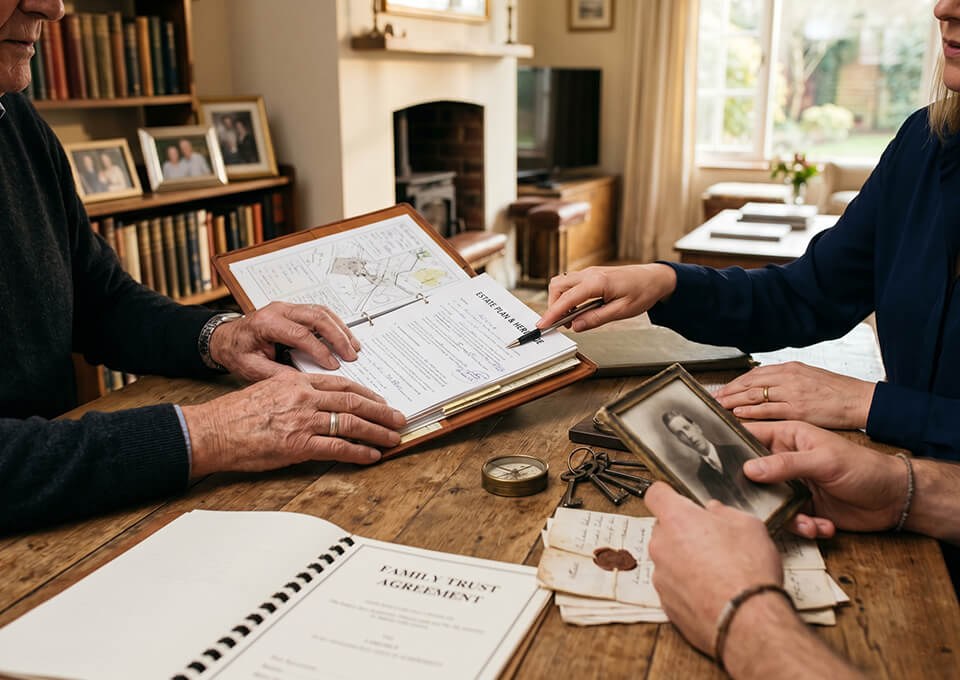
The most consistently difficult aspect of multigenerational asset preservation is not the financial structuring or the governance design, as important as both are. It is the family conversations, the discussions about expectations, intentions, roles, and values that must happen openly and honestly if the next generation is to take on genuine stewardship responsibility rather than simply passive financial interest in an inherited portfolio.
These conversations are difficult in every family and every culture. In the Mauritius context, where family and community relationships are particularly close-knit and where business and personal lives are often deeply intertwined within the island’s relatively compact social environment, these conversations can be especially sensitive and complex to navigate. But deferring them, which is the instinct of most families, who prefer to believe that these matters will sort themselves out naturally when the time comes, is almost always more damaging than having them early, even imperfectly and with some discomfort.
What the Next Generation Actually Needs to Know About the Apavou Group
The preparation of the next generation for stewardship of a real estate legacy like the Apavou Group’s Mauritius portfolio is not primarily about financial education or legal training, though both are genuinely important components. It is about understanding and internalising the story, the decisions that were made, the values that guided them, the mistakes that were learned from and the course corrections that resulted, and the principles that have been non-negotiable through every market cycle and every family transition since the group’s founding. Without this story, the next generation may inherit the assets but not the understanding that enables them to steward those assets with the same intelligence, conviction, and long-term orientation that built them. The buildings of Plaisance Mall, The Cube, and Terre d’Été tell part of the story. The human decisions behind them tell the rest.
The Role of Trust in Multigenerational Preservation
Trust, between family members, between the family and professional advisers, between the asset-owning family and the professional management of the group, and between the group and the communities of Mauritius in which its assets are embedded, is the invisible infrastructure of multigenerational preservation. Without trust between family members, governance structures become adversarial forums rather than collaborative decision-making bodies. Without trust between the family and its advisers, decisions are made without the candid professional counsel they require. And without the trust of the Mauritius community, built by the Apavou Group through decades of quality development, consistent business conduct, and active community engagement, the social licence to develop and operate that the group currently enjoys would be fragile and vulnerable.
Building and maintaining this multi-dimensional trust is a continuous and entirely human endeavour. It cannot be delegated to a legal document or outsourced to a communications strategy. It requires consistent behaviour, in keeping every commitment made, in dealing fairly with all parties in every transaction, in maintaining the quality standards that the group’s reputation has been built on, across every dimension of the group’s activity and across every generation of its leadership.
Conflict as a Natural Part of Multigenerational Stewardship
It would be unrealistic and unhelpful to suggest that multigenerational preservation is a conflict-free process. Families disagree about strategy, about the appropriate balance between distributions to family members and reinvestment in the business, about which family members should play which roles in the group, and about the values that should guide specific commercial decisions. In the Mauritius context, where business families often operate in close physical and social proximity and where commercial and personal relationships are deeply intertwined, these conflicts can be particularly complex and personally difficult.
Accepting that conflict is a natural and even healthy part of the governance of a multigenerational real estate group, and investing in the processes and professional relationships needed to manage conflict productively rather than destructively, is one of the most important organisational capabilities that a family business like the Apavou Group needs to cultivate deliberately. The key is not to eliminate disagreement but to ensure that it is resolved through structured discussion and agreed process rather than through personal power struggles that damage both family relationships and the business whose continuity all parties ultimately share an interest in protecting.
The Decision to Professionalise
A critical human decision in the evolution of any family real estate business, and one that the Apavou Group has navigated as part of its four-decade development in Mauritius, is the decision to professionalise: to bring in non-family professional management at senior levels, to create formal governance structures with independent participation, and to apply institutional-quality standards and processes to what has previously been managed with more informality and personal discretion.
This decision is frequently resisted by founding generations who have built the business on the authority of personal judgment and informal relationship networks, and who may perceive professionalisation as an implicit criticism of their prior approach. In reality, professionalisation is not a repudiation of the founding generation’s contribution, it is the appropriate adaptation of the organisation to the greater complexity and external expectations that success and growth inevitably create.
What Professionalisation Means for the Apavou Group’s Mauritius Operations
For the Apavou Group, professionalisation has meant maintaining the founding values and long-term orientation that Armand Apavou established while building the management infrastructure, governance structures, and external relationships needed to operate effectively at the scale and complexity that the group’s Mauritius portfolio now represents. The ability to develop, finance, and manage major commercial assets like Plaisance Mall and The Cube alongside quality residential developments like Terre d’Été, and to do so to consistently high standards across multiple concurrent projects, reflects the level of organisational capability and professional infrastructure that the group has built over time.
Preservation Is a Human Achievement
The preservation of a multigenerational real estate legacy like the Apavou Group’s Mauritius portfolio is ultimately a human achievement, the accumulated product of countless individual decisions made well, of relationships maintained with care and consistency, of conflicts resolved with wisdom and respect, and of values transmitted with genuine conviction across the generations that have shaped and will shape the group. No governance document, no legal structure, and no financial strategy can substitute for the quality of these human elements. They are the foundation on which everything else rests, the invisible but essential bedrock of everything that Armand Apavou has built in Mauritius, from the first project to the last.
 Previous Post
 Next Post